
Permissions and Access Management
Permissions and Access Management allows you to define what actions each user can perform in the Stripo Plugin editor.
This ensures that only authorized users can view or modify emails, modules, or related resources.
All permissions are managed on your backend — the Stripo Plugin enforces them automatically.
How it works
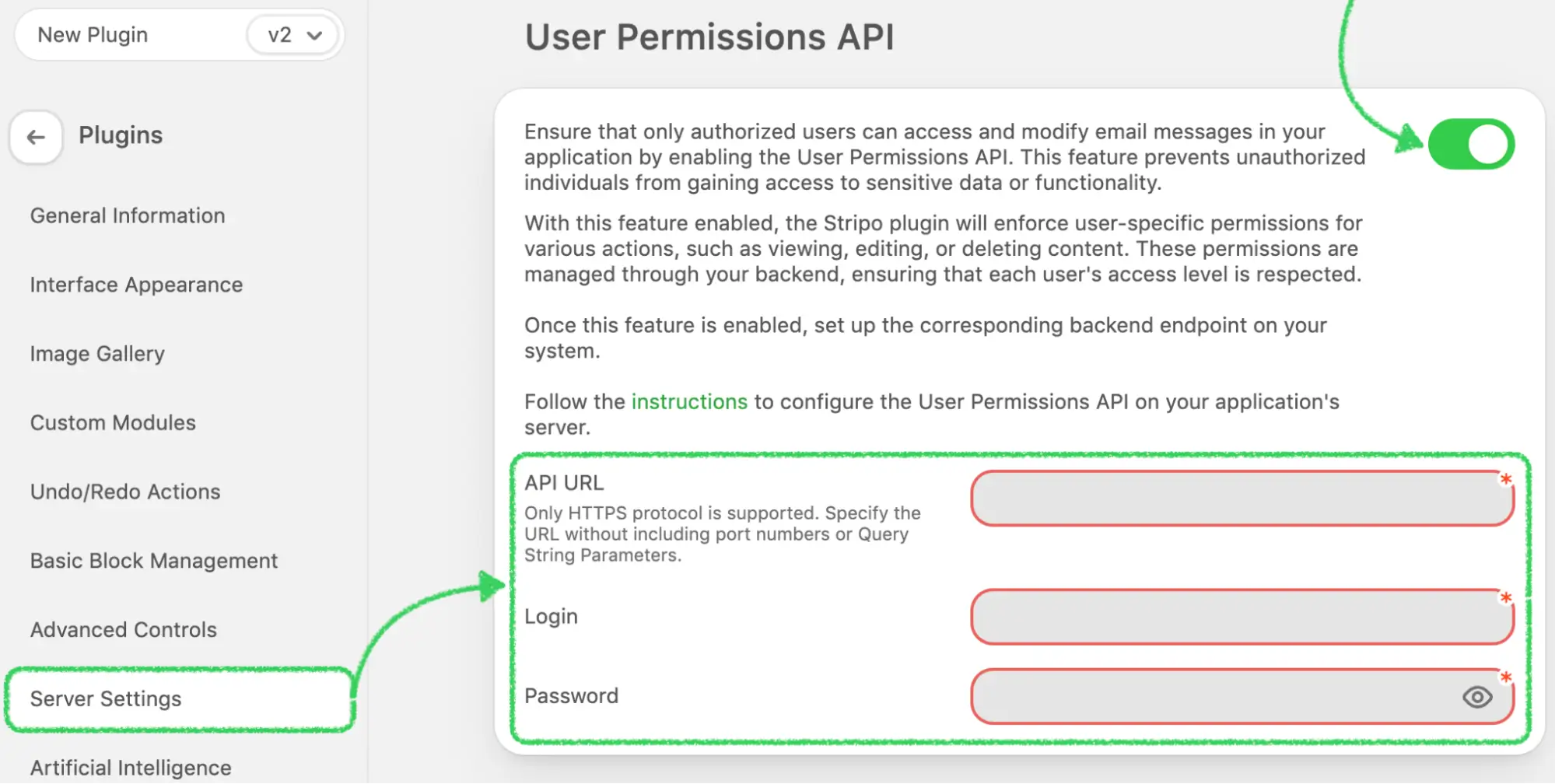
Enable the User Permissions API in your Stripo Plugin account: Plugin → Server Settings → User Permissions API.
Provide your backend endpoint URL and Basic Authentication credentials.
When the editor is initialized, Stripo will call your endpoint with the
ES‑PLUGIN‑UI‑DATAheader, which contains themetadatayou passed in the plugin initialization script.Your backend must respond with a JSON object that specifies which actions are allowed for this user.
Based on the response, the Stripo editor will enable or disable features accordingly.
Response format
json
{
  "codeEditor": {
    "read": true,
    "write": false
  },
  "appearance": {
    "read": true,
    "write": false
  },
  "content": {
    "read": true,
    "write": false,
    "textOnly": false
  },
  "modules": {
    "read": true,
    "write": false
  },
  "versionHistory": {
    "read": true,
    "write": false
  },
  "manageOwnComments": {
    "read": true,
    "write": false
  },
  "manageAllComments": {
    "read": true,
    "write": false
  },
  "accessibilityTesting": {
    "read": true,
    "write": true
  },
  "elementsLock": {
    "read": true,
    "write": true
  },
  "urlValidation": {
    "read": true,
    "write": true
  }
}
Permissions reference
The response object supports the following permission groups and actions:
| Permission | Action | Description |
|---|---|---|
codeEditor | read | Allows the user to open and view the HTML code editor. |
write | Allows the user to edit and save changes in the HTML code editor. | |
appearance | read | Allows viewing appearance settings (fonts, colors, styles). |
write | Allows modifying and saving appearance settings. | |
content | read | Allows opening and viewing template content. |
write | Allows modifying content (adding/removing blocks, changing layout, etc.). | |
textOnly | Allows editing only text values without changing layout or design. | |
modules | read | Allows browsing and inserting custom/saved modules. |
write | Allows creating, updating, or deleting modules. | |
versionHistory | read | Allows viewing the template version history. |
write | Allows restoring the versions. | |
manageOwnComments | read | Allows the user to view the Comments tab and see comment threads created by them. This permission controls the visibility of the tab: it is shown if either manageOwnComments.read or manageAllComments.read is enabled, and hidden only when both are disabled. |
write | Allows the user to create new comments. Authors can edit, delete, resolve, reopen, and move their own comments when they have read access. | |
manageAllComments | read | Allows the user to view the Comments tab and see comments created by all users. When this permission is disabled but manageOwnComments.read is enabled, the user sees only their own comment threads. |
write | Allows the user to edit, delete, resolve, reopen, and move comments created by other users, providing moderation capabilities. | |
accessibilityTesting | read | Allows the user to enter the Accessibility Testing Mode. |
write | Allows the user to edit the email while Accessibility Testing Mode is active. If disabled, the email will be available in view-only mode during accessibility testing. | |
elementsLock | read | Reserved for consistency with the permission model. Currently has no effect on the editor behavior. |
write | Allows the user to lock and unlock elements (stripes, structures, containers) and to edit locked elements. Takes effect only when the Lock Element feature is enabled with the elementLockEnabled initialization parameter. Users without this permission cannot change the lock state and cannot modify the locked content or styles of locked elements. | |
urlValidation | read | Allows the user to open URL Validation Mode, run and re-run the link check, and view the results. See URL Checker. |
write | Allows the user to edit a link from the results panel and apply the change to one element or to all elements that use the same link. If disabled, the results are available in view-only mode. Applying a fix also requires content.write. |
Example scenarios
- Full editing
Grantread: trueandwrite: truein all permissions. - Read-only access
Grantread: trueand set allwrite: false. - Text-only editing
Grantcontent.read: trueandcontent.textOnly: true, withcontent.write: false.
API Reference
For details on the request/response format, see User Permissions API → GET method.